Don’t Get Mad—Get Clear: Why Language Matters More Than Your Pride

Words Build Bridges—But Only When They’re Understood

It’s hard being told you’ve made a mistake. Especially when it’s something as personal as your own words—your thoughts, your expression, your message. But here’s the truth: communication isn’t just about getting your feelings out—it’s about making sure others can actually understand them.

When you’re careless with spelling or grammar, you’re not just being “creative” or “casual”—you’re making it harder for others to connect with what you’re saying. And when someone gently corrects you, especially in a group where others are confused, it’s not an attack. It’s clarity. It’s connection. It’s actually kindness.

Miscommunication Feeds Misunderstanding

So many fights between friends, classmates, or online groups begin because of one thing: someone misunderstood what someone else meant. And often, that’s because the original message was rushed, messy, or full of errors.

Yes, it’s okay to make mistakes. But if people are telling you they don’t understand what you said, that means there’s a breakdown in connection. That’s your moment to fix the bridge—not set fire to it.

Being Corrected Is Not Being Attacked

If someone politely says, “I think you meant this” or “Do you mean XYZ?”—they’re not trying to shame you. They’re trying to clarify something so others can understand it too. That’s not bullying. That’s not “being rude.” That’s someone actually making the effort to keep the conversation clear and flowing.

When you snap back or get offended, you shut down learning—and you make the person trying to help feel like they’ve done something wrong for simply wanting everyone to be on the same page.

Grammar Isn’t Just School Stuff—It’s Social Survival

Think of grammar and spelling like road signs. If all the signs on the road were spelled wrong, nobody would know where to go. There would be crashes and chaos. It’s the same with communication. Your sentence is a map to your thoughts. If the map is blurry, no one can follow.

This isn’t about being “perfect” or “posh.” It’s about making sense. It’s about being heard.

What You Can Learn From This

If someone corrects your spelling or grammar:

• Pause. Take a breath.

• Ask yourself: Was my sentence confusing?

• Ask: Is this person trying to help others understand?

• Say: Thank you. Because guess what? They cared enough to help you be understood.

Be Bigger Than Your Ego

Getting defensive over a correction wastes your energy and pushes people away. It creates walls instead of windows. If you’re serious about being heard, seen, and respected, you have to take responsibility for how you speak and write.

Language is power—but only if people can actually understand what you’re trying to say.

TO THE KIDS WHO FEEL CONFUSED OR OFFENDED

You’re not weak for feeling hurt. But you are stronger when you choose to learn instead of lash out. Every time someone clarifies something you said, it’s a chance to grow sharper, stronger, and more connected to the world around you.

Don’t waste that chance. Don’t waste your voice.

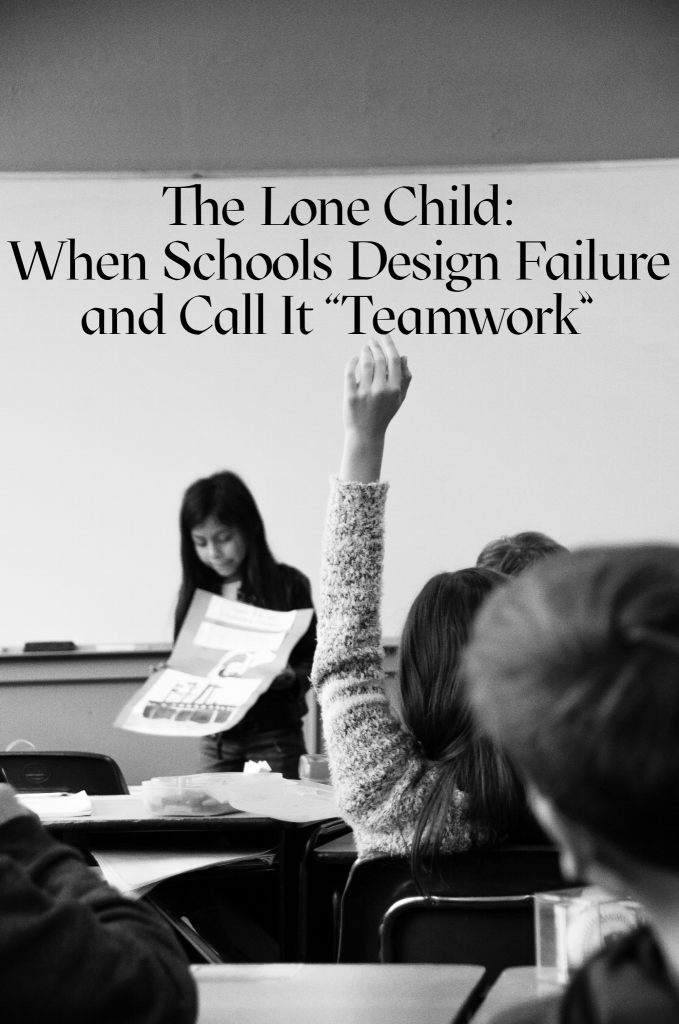
The Lone Child: When Schools Design Failure and Call It “Teamwork”

How do you teach your child to rise — when every system is rigged to keep them on their knees?

Sending Your Child to School in a War Zone (Without Armor)

It takes a certain kind of courage to send your child into a building every day where they are hated. Not disliked. Not unpopular. Hated. Viciously, irrationally, religiously — as if hating your child is a moral obligation for the rest of the student body.

Because if someone dares to be kind? If someone dares to not mock, exclude, or dehumanise your child — then they’ll become the next target. Welcome to the psychology of mob mentality. Welcome to the cowardice of adolescence. Welcome to the failure of a school’s moral backbone.

And still, we send them.

We wipe their tears. Pack their lunches. Zip up their bags and pray. Every morning is an act of faith. Every afternoon, a sigh of relief that they made it home again. Intact.

But resilience? Resilience is not built in peace. It is forged in fire. And my child — my beautiful, brilliant child — is nothing short of flameproof.

But Then the System Gets Involved — and It Gets Worse

You would think the bullying would be the worst of it. The dirty looks. The whispers. The games of “you can’t sit here.” The celebrations when she’s absent. The fake smiles from teachers who know damn well what’s going on.

But no. It’s the curriculum that breaks you.

Group work.

Every. Single. Class.

Even in maths. Even in science. Even in things that should be about logic, about thinking, about independence — schools have swallowed the lie that “collaboration” is the holy grail of learning. So now, your grades don’t just depend on your mind. They depend on whether your tormentors are willing to let you participate.

Spoiler: they’re not.

Your child becomes the child no one wants in their group. Not because she can’t contribute — she can. She’s brilliant. But because associating with her is social suicide. Because exclusion is currency, and everyone is desperate to buy safety.

And worse? These group assignments aren’t optional. They’re worth 50% of the grade in most subjects.

The school doesn’t care. The teachers shrug. “It’s how the world works,” they say. No, it’s not. In the real world, if someone harasses you at work, you can report them. In the real world, you don’t get forced to co-sign your future with someone who hates your guts. In the real world, abusers don’t get to tank your success because they’re too immature to behave like human beings.

But in school? They do.

Resilience Is Not Enough When the System Is Rotten

I’ve raised my child to be resilient. I’ve taught her not to crumble when people throw stones. She’s learned to sit alone at lunch. To read when no one wants to talk. To be strong when the world is cruel.

But how do you teach a child to survive a system that is designed to fail them?

When group tasks are mandatory. When friendships are weaponised. When teachers blame the victim because it’s easier than challenging the mob. When being intelligent, kind, or simply different makes you a target.

What then?

What I’ve Learned: You Can’t Outsmart a Rigged Game, But You Can Call It What It Is

I used to think that if I just taught my child to be stronger, kinder, smarter — we could beat the system. We could outlast the hate. We could rise above it.

But the truth is darker than that.

Because some systems aren’t broken — they’re functioning exactly as designed.

A system that protects bullies and punishes outcasts. A system that rewards silence and punishes advocacy. A system that enforces group tasks and calls it “collaborative learning” — knowing full well that the kids forced into groups are the same kids who get tormented by those groups.

We need to stop pretending this is education. This is sanctioned cruelty with a rubric attached.

Let This Be Your Reminder: Your Child Deserves Better

If your child is going through this, I see you. I see them.

I know what it’s like to help with an assignment your child will never get credit for because her group shut her out. I know what it’s like to have to write emails you know will be ignored. I know what it’s like to watch your child become a shell of who they once were — not because they’re broken, but because they’re being buried alive under the weight of a cruel, cowardly system.

But this isn’t the end.

Keep advocating. Keep pushing. Keep writing. Keep building your child’s strength. Remind them that being excluded by the heartless doesn’t mean they’re unworthy — it means they’re different. And difference is power.

Because if they can survive this, they can survive anything. But let’s make damn sure they don’t have to.

The Birthday Call That Broke Something In Me

When you give your children a choice, and they choose kindness – only to have cruelty meet them at the door.

This morning, I stood at a painful crossroads. It was my mother’s birthday—a woman who has caused me years of pain, manipulation, and deep emotional wounds. A woman who has, despite everything, managed to live on with strength seemingly drawn not from grace or goodness, but from control and narcissism.

And today, I gave my children a choice. I sat with them and explained the truth: that they were not required to wish her a happy birthday, that they were free to do whatever they felt in their hearts.

Some of them chose to call her—soft-hearted, young, and innocent—“just in case it’s her last birthday,” they said.

They were being bigger than the pain. They were doing what they thought was kind.

And so we called.

And called.

And called again.

Only to discover the truth: my mother has blocked me. Her phone wouldn’t ring. Her number refused our calls. The hopeful little faces beside me slowly turned to confusion, then sadness.

She blocked me—and by doing so, she blocked her own grandchildren too.

Not even for her birthday would she allow us the dignity of reaching out. Not even for the sake of the children.

And I realised, in that moment, how deep her cruelty runs.

This wasn’t just rejection—it was deliberate. Strategic. Her own warped version of punishment. A final insult wrapped up in silence.

I watched my children try to make sense of it. I watched them hurt, quietly. And I ached, not just for them, but for the part of me that still, after everything, hoped for decency. Hoped for something better.

But this is the lesson.

This is the truth.

You cannot force love where love has never lived.

And no matter how good you are, how pure your heart, how brave your children…

You cannot squeeze water from a stone.

And you cannot heal through hope alone.

Today, my children saw what I’ve spent a lifetime surviving.

Today, I stop feeling guilty for the boundaries I set.

And today, I hold my head high, knowing that even if the door was slammed in our faces, we tried. We tried with grace.

We tried with love.

And she chose silence.

That’s not our failure.

That’s her legacy.