The Weight of Their Words: What the Bullies Should Be Feeling Now

Even if they didn’t cause her death, they helped shape her final days

They may not have put her in the ground, but they helped push her to the edge.

There are moments in life that call for deep, painful self-reflection. The death of a classmate—especially a bright, happy, kind soul who once lit up a room—is one of them. When a child dies, we often ask “how?” But rarely do we ask, “who helped make her final days so hard?” That question doesn’t need to point fingers at a cause of death—it needs to hold people accountable for how she was made to feel in the weeks, months, and years before it.

This is about the children who tormented her, ridiculed her, isolated her.

The ones who made her feel like she didn’t belong.

The girl who told her to kill herself.

The many who laughed behind her back, excluded her, and left her in the dark—alone.

Whether her death is labelled an accident or not, they should feel something. They must.

You don’t have to be the reason someone died to be the reason they suffered

No one’s asking the bullies to carry a burden they didn’t directly cause. But what about the burden of the girl they helped break down? What about the cruel words, the humiliating moments, the absolute silence in the face of her pain?

She didn’t attend school for weeks. She couldn’t. It was too unsafe. Too cruel.

How must her last weeks have felt—being cut off from joy, from friends, from dignity?

Every laugh behind her back.

Every group chat message mocking her.

Every moment they turned their backs instead of standing up for her.

That’s what they should be thinking about.

Not because they killed her. But because they helped kill her joy.

You don’t get to take it back now

To the girl who told her to kill herself—what now?

Do you feel a pit in your stomach?

Do you lie awake at night hearing your own words replaying in your head?

You can’t unsay it.

You can’t tell the universe you “didn’t mean it.”

You don’t get to soften the blow of cruelty just because her death wasn’t officially linked to your words.

Because regardless of the label placed on her death—accident or otherwise—your voice was part of the darkness that clouded her final weeks.

What parents of bullies should be asking themselves

If your child was cruel to her, you should be asking:

• What kind of child am I raising?

• Have I taught them empathy, or have I made excuses for their behaviour?

• If my child was unkind to a girl who is now gone—what am I going to do about it?

Don’t wait for the school to discipline them. Don’t brush it off as “just kids being kids.”

If your child’s voice was one that mocked or ignored a girl in pain, they need to understand that words matter. That silence is complicity. That cruelty stains you, even after someone is gone.

What we all need to learn from this

We must stop normalising cruelty as a phase.

We must stop treating bullying as a footnote.

We must stop failing children by ignoring the warning signs.

Even if her death was an accident.

Even if her family believes it was not caused by the bullying.

We still owe it to her—to her memory—to be honest about how she was treated.

We still owe it to other children who are suffering in silence.

Let this be a turning point. Let this be the moment we stop excusing the inexcusable.

Because if we don’t—then we are all complicit in the next tragedy.

What They Should Be Feeling

You didn’t put her in the ground. But you were part of the reason she couldn’t stand to be here anymore.

She’s gone. And you kept living like nothing happened.

Not a flower at the gate.

Not a card. Not a candle.

No teddy bears. No quiet circles of grief.

No stunned silence in the hallway.

Just school. As usual.

Laughter. As usual.

Cruelty. As usual.

And that’s the most damning part of all.

When a child dies and no one flinches, no one gathers, no one mourns—what does that say?

What does that reveal about the people who surrounded her in her final days?

You didn’t have to kill her to help erase her joy

She was already avoiding school. She was already staying home, afraid to walk the halls.

She was already dreading each morning.

She was already broken long before her final breath.

And you knew that.

Some of you saw it.

Some of you laughed at it.

Some of you made it worse.

And now—she’s gone.

Whether her death was an accident or not isn’t even the point anymore.

The point is: her life became unbearable—and some of you made sure of it.

To the one who told her to kill herself—

Are you sleeping well?

Do you hear your own voice in the dark?

Telling her the exact thing that so nearly came true?

What did you expect? That your words would disappear?

That she’d bounce back? That she’d just laugh it off?

She didn’t.

She didn’t laugh.

She didn’t bounce.

And now you will have to live with that voice in your head for the rest of your life.

The one that said it. Out loud. To a girl who is no longer here.

To the parents of the bullies—what exactly are you raising?

Do you still believe your child is “just a kid”?

Do you still think it’s harmless teasing?

Do you still tell people your child would never be that cruel?

Because here’s the truth: they were. And they weren’t alone.

Your child’s words might not have ended her life,

but they chipped away at it,

day after day,

until it barely felt worth living.

If that doesn’t shake you to your core, you’re failing your child just as much as they failed her.

You don’t get to rewrite what you did

She’s gone.

You can’t take back the texts.

You can’t undo the silence when she sat alone.

You can’t reverse the decision to “just walk away” while she was drowning in humiliation.

You don’t get to decide now that you “weren’t part of it.”

You were.

And even if you weren’t throwing stones—you still stood and watched her get hit.

That makes you part of the damage.

That makes you part of the story.

Imagine what her last month could have looked like

She could have laughed more.

She could have come to school without fear.

She could have sat with friends at lunch,

instead of hiding in corners or staying home completely.

She could have made memories.

She could have felt light, even once.

But she didn’t.

Because of you.

Because of your kids.

Because of what this school allowed.

The lesson?

If you are cruel to someone,

and they die—accident or not—you are not innocent.

If your words drained the colour from her days,

you don’t get to pretend your hands are clean.

You don’t get to look the other way now.

You helped dim her light.

You helped teach her that the world was unkind.

You helped make life unbearable, even if you didn’t make death inevitable.

And if that doesn’t haunt you—

you’ve learned nothing.

No Flowers at the Gate: What Silence Says When a Child Is Gone

When a School Forgets, the Pain Echoes Louder

There were no flowers tied to the school gates.

No ribbons.

No teddy bears.

No candles.

No cards.

No signs of heartbreak.

No signs that a child—one of their own—had just disappeared forever.

If this was truly unexpected… where is the shock?

If this was truly an accident… where is the devastation?

What we see instead is silence. An eerie, telling silence that speaks volumes about what this community really feels—and what it doesn’t.

The Hidden Cost of Protecting Bullies

This student—bright, fragile, kind—was hidden away from regular classes “for her own protection.” Her attendance faded. Her light dimmed. She was removed from classrooms rather than removing the ones tormenting her. She was made invisible, as though her pain was inconvenient.

The bullies? They stayed. They were allowed to learn, laugh, exist—untouched.

The school didn’t teach accountability. It taught cruelty a safe place to thrive. It showed the entire student body that if you push hard enough, we won’t protect the victim—we’ll erase them. Quietly. Without fuss. Without justice.

And now they’ve erased her completely.

No Signs of Grief, No Symbols of Shock

In the wake of any true tragedy—especially the sudden, accidental death of a child—you expect to see a community shaken to its core. You expect flowers. Cards. Mourning students clustered at the gates. A ripple of grief that cannot be contained.

But here? There’s nothing.

Not a single child has tied a ribbon.

Not a single tribute stands at the place where she once walked.

This isn’t just silence. It’s willful erasure. It’s guilt. It’s complicity.

Because deep down, they all know.

They know what she endured.

They know how many years she was targeted, pushed, alienated.

They know what they said to her—and what they didn’t say when it mattered.

They know what kind of school culture allowed this to happen.

So there are no flowers. Because that would mean facing it.

And facing it would mean admitting they were part of it.

What Are We Really Teaching Our Children?

The message is loud and clear:

If you are cruel enough, the school will protect you.

If you are suffering, we will hide you—then forget you.

This is not just a tragedy. It is a teaching moment lost. A warning silenced. A life erased without consequence.

What the school is doing now—brushing it under the rug, refusing to speak her name, pretending nothing happened—is the same thing they did when she was alive. Deny. Minimize. Move on.

But the pain lingers. The questions remain. The truth doesn’t go away.

Silence Isn’t Respect—It’s Evasion

Some say we should respect her memory by not asking questions.

But how can you respect someone’s memory if you won’t even acknowledge their pain?

How do you honor a life while pretending the cruelty that shadowed it never happened?

This isn’t respect. It’s fear.

It’s fear of accountability.

It’s fear of confronting the toxic culture that was allowed to flourish under their watch.

And that fear has cost a life.

Let this not be another forgotten name.

Let this silence not be the final word.

The Lesson Behind a Tragedy: When We Don’t Listen, We Lose More Than a Child

A reflection on grief, silence, and what happens when we look away for too long

A Devastating Loss, and a Divided Grief

Recently, a young girl lost her life — suddenly, tragically. Her parents believe firmly that it was an accident. Out of deep respect for their grief, their wishes must be honored. They deserve peace, and their daughter deserves dignity.

But grief has many faces. And for those who loved her, who knew her quiet pain, the tragedy feels layered… and unbearably familiar.

The Unspoken History

Before her death, this girl had not attended school for weeks — possibly months. She had faced years of ongoing bullying, starting in primary school and tragically continuing into high school. The very same bullies followed her into a new chapter of life and made sure she carried the trauma with her.

She withdrew. From school. From friendships. From the joy that should have belonged to her youth.

Friends recall messages — raw, confessional — about suicidal thoughts. She told people she didn’t want to be here anymore. She was told to kill herself. Her absence from school wasn’t about laziness or disinterest — it was fear. It was emotional exhaustion. It was a desperate attempt to escape cruelty.

Respecting the Family, While Also Respecting the Truth

This article isn’t meant to point fingers or assign blame. The family has stated that this was an accident. That must be heard.

But so must the rest.

To deny the bullying — to erase it from the story entirely — is to erase years of pain. It sends a dangerous message to every child who has ever felt the same. It makes the others feel unseen. And it lets those who inflicted that pain walk away without reflection, responsibility, or change.

What Happens When We Pretend It’s Not Real?

When we strip bullying out of the conversation after a tragedy, we do more than protect reputations. We protect the problem.

We raise children who learn that cruelty is consequence-free. We raise systems that respond to crisis only when it becomes unignorable. And we leave grieving friends — like my daughter — to wrestle with impossible questions:

“Why did no one stop this?”

“Why is everyone acting like this had nothing to do with it?”

“Why did her mum tell me not to let the bullies win… and then say it was just an accident?”

That contradiction is what breaks the heart open again and again. It’s not about blame — it’s about integrity.

The Real Lesson We Can’t Afford to Miss

The lesson here isn’t to point at the past and burn it down. It’s to illuminate it. To say, loudly:

• Children don’t lie about being bullied.

• School refusal is not a character flaw — it’s often a trauma response.

• When kids tell us they’re scared, or thinking about ending their lives — we must believe them.

• And when someone is lost, we must examine the full truth. Not just the parts that feel easiest to manage.

Honouring Her by Changing What Must Be Changed

This beautiful, gentle girl should never have had to carry such a heavy burden. The lesson behind her death — whatever the cause — is not just that life is fragile.

It’s that we have to do better.

We owe it to her. To every student who suffers in silence. To every family who shouldn’t have to wonder if a child’s life could have been saved by compassion, early intervention, and accountability.

Keep Your Condolences — They Mean Nothing Without Courage

When grief becomes performative, silence is more honest.

It’s a strange kind of cruelty — offering your condolences with one hand, and turning your back with the other.

My daughter received a message — soft, kind, sorrowful — from someone who used to be her friend. Someone who had once laughed with her, and more recently, laughed at her. Someone who once knew her inside out, and now won’t even stand beside her in the hallway.

This girl messaged my daughter after the death of her best friend. She offered condolences. Words of comfort. A digital candle in the storm.

And when my daughter — raw, grieving, desperate for connection — said, “Can we please rebuild our friendship?”

She was met with silence.

You don’t get to break someone, then pretend to care when they’re shattered.

No.

Worse than no.

Nothing.

Ghosted. Erased. Forgotten again.

Because some people only want to be seen grieving, not actually feel it — not sit in it, not show up for the ones left behind.

The silence screamed louder than any message. And the grief? It got heavier.

You don’t get to offer your sympathy, pose as the wounded soul, and then bolt the moment someone needs you. If you do, then your sympathy was never real. It was a mirror for yourself — not a light for someone else.

Friendship doesn’t end at the funeral gates.

True friendship doesn’t dissolve under pressure. It doesn’t hide when the moment is hard.

It doesn’t vanish when someone asks for warmth.

You can’t send your “I’m so sorry for your loss” texts and then vanish when someone asks for human connection. That’s not kindness — that’s cowardice.

And to those who perform compassion while refusing to practice it — let me tell you something painful:

Your fake condolences are more hurtful than saying nothing at all.

Because pretending to care is not harmless.

It’s another form of emotional abandonment — and sometimes, it hurts just as much as the loss.

🕊 A Message From My Heart — About the Recent Tragedy, the School’s Email, and What I Truly Meant 🕊

Screenshot

I never imagined I’d be writing something like this – especially not after something so heartbreaking.

As many of you know, a local teenage girl recently passed away. A beautiful soul – gone far too soon.

In the midst of deep grief, I made a private post in a mums’ group. I didn’t mention any names. I didn’t mention the school. I never claimed to know exactly what happened. I simply expressed what many others were already quietly wondering – whether long-standing, well-known bullying could have played a role.

Because the truth is – this young girl had not attended school for weeks, possibly months. She had been severely bullied for years, by the same students, all the way from primary into high school.

And yes – there are text messages that clearly referenced painful thoughts. (These are now known and will be passed to the appropriate people.)

So no –  it was never my intention to spread misinformation or make accusations.

It was never about blame.

It was about grief. Shock. Patterns too painful to ignore.

What truly confused and shook my daughter – and many others – was a message she received from the girl’s mother shortly after her death:

“Don’t let the bullies win.”

That one sentence has been echoing in our home.

But now, we are told by the school and others that this was simply a tragic accident – and had nothing to do with bullying.

And I want to say: I hear that. I accept that. And if this was a complete and unrelated tragedy, then I am truly, genuinely sorry for ever implying otherwise.

But I also want to say this…

The School’s Email Felt Like a Public Shaming

Today, the school issued an email that referred to my post, stating it made “incorrect claims” and was “not factual.”

Let me be very clear:

  • I never claimed to know the full truth.
  • I never identified the child, the school, or any individuals.
  • I spoke from a place of concern, sadness, and compassion.

The fact that this email was sent to the entire parent community felt like a public attack on my character, as if I had maliciously spread lies – which I did not.

And now, I’m being bullied – again – by the same group of mothers whose children have bullied my own daughter for years.

The irony and pain of this is not lost on me.

So, Here’s What I Want to Say

Before I receive any more hate…

Before I’m judged or blamed or shamed any further…

Let me raise my hands and say: I’m sorry.

I’m sorry if my post caused anyone more pain in an already heartbreaking time.

I’m sorry if it came across as insensitive – that was never, ever my intention.

I now understand that the family believes this tragedy was not related to bullying, and I respect that. And I will never speak over a grieving parent.

But please, understand that I am grieving too.

My daughter is grieving her friend.

And so many of us are just trying to make sense of a senseless loss.

The coincidences, the history, the silence – it all left us stunned. The emotion behind my post came from that space.

Let’s Remember Why This Hurts So Much

Because a child has died.

A beautiful child who should still be here.

Let’s not let our fear of being wrong make us cruel to those who are hurting.

Please – let’s lead with kindness. Let’s give one another the benefit of the doubt. Let’s protect our kids – and each other – with love, not control.

With sincerity and heartbreak,

Rochelle

You Mock My Daughter’s Face? Then You’re Exactly What’s Wrong With This World

The Envious Die Not Once, But As Often As The Envied Win Applause

Let’s not pretend anymore.

Let’s not sugar-coat cruelty with the words “kids will be kids.”

Let’s call this exactly what it is: violence.

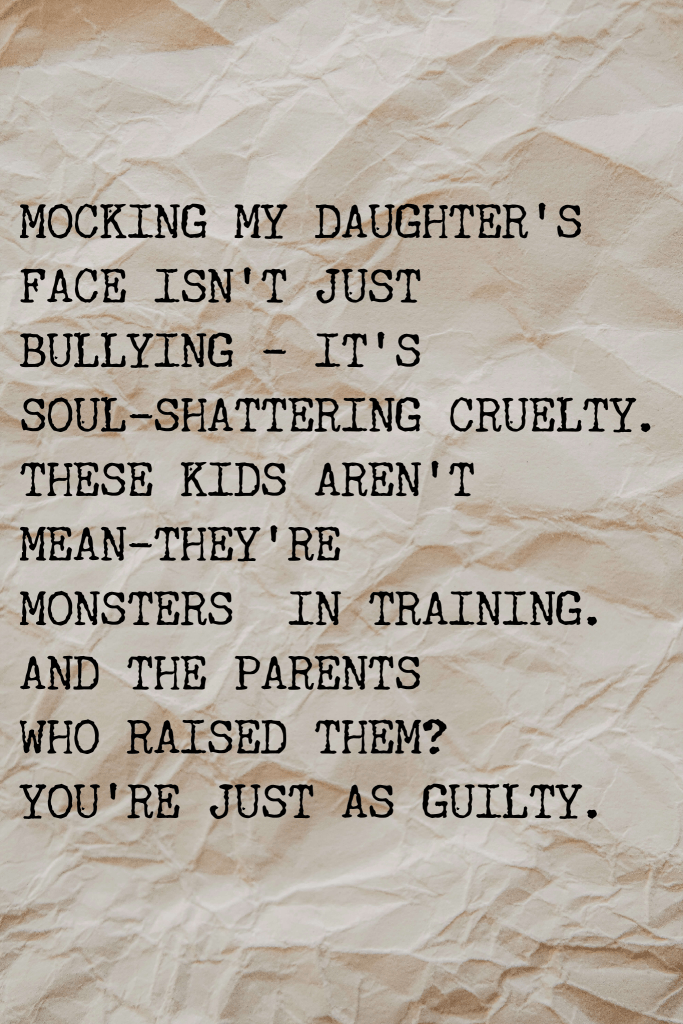
Today, during a quiet school moment that should have been safe—a grade assembly—a girl decided it would be hilarious to mock my daughter’s face.

Yes.

Her face.

The one thing she can’t change.

The face I’ve kissed a thousand times. The face I adore.

This evil little creature, who’s been trailing my daughter since primary school like a bad smell, decided that it was her moment to shine. She contorted her face—mimicking, mocking, humiliating—in front of the entire Year 8 cohort.

To impress her five likeminded friends.

To get laughs.

To dehumanize my child.

Her actions didn’t stop there — next came her verbal assault:

“Look at her shoes—they look retarded.”

That’s what she said — it’s part of who she is as a person. That’s what a child raised by other humans thought was acceptable.

These Girls Aren’t Mean. They’re Monsters in Training.

Let me be very clear: this is not a phase. This is not a mistake.

This is cruelty.

This is violence.

This is premeditated emotional destruction.

And it didn’t stop there.

Another girl—from an entirely different toxic group of students—decided she would throw a pen at my daughter shortly after.

Two different packs of wolves.

One target.

This is pack mentality, and their only goal is to break her.

Don’t You Dare Say “It’s Just Kids Being Kids”

No. These are not harmless kids. These are bullies being raised by adults who model this behavior.

Because it’s not just in the school yard—it’s in their homes.

Parents who excuse it.

Parents who enable it.

Parents who make snide remarks about families like mine, because they assume we’re “better off.”

Because they see a child with nice shoes and decide that child deserves to be torn apart.

This isn’t about shoes. This is about jealousy.

This is about poverty of character.

Let’s Talk About Those Shoes, Shall We?

Powder pink Nike Shox.

A bold, iconic staple in the Nike brand.

Expensive. Well-loved. Desired.

If they’re so “hideous,” why are they flying off the shelves?

Why are they everywhere in the fashion scene?

Why are people lining up to buy them?

Because they’re not hideous.

Your insecurity is.

And those shoes?

They weren’t easy to afford.

They didn’t come from nowhere.

I Sacrifice So Much for My Children—And I’d Do It Again Tomorrow

I don’t spend my weekends getting my nails done.

I don’t splurge at the hair salon.

I don’t party or go clubbing or waste money on things that don’t matter.

You know what I do?

sacrifice.

So I can give my children joy.

So I can see their eyes light up when they get something special.

So I can build them up in a world constantly trying to tear them down.

And then a pack of miserablemean-spirited children tries to rip that joy away.

Bullies Don’t Just Happen. They’re Raised.

The comments we’ve already heard from their parents this year?

Unforgivable.

Things like:

“You wouldn’t understand where we’re coming from.”

“It must be nice to be you.”

“We’re just trying to get by.”

Translation?

“If someone seems to have more than us, let’s torment them for it.”

What kind of twisted logic is that?

You hate your own poverty so much, you attack a child for having a pair of shoes?

Let’s be real.

If you’re raising a child to hate others for having nice things, you’ve failed as a parent.

And if your child is bullying others for their face?

You’ve raised a monster.

Jealousy is a Mental Cancer

To the girl who threw the pen:

Your aim is weak, just like your character.

To the girl who mocked my daughter’s face:

You will never break her. You will never reach her level. You don’t even deserve to be in her presence.

And to the parents of these girls:

Do better.

Your children are proof that hate starts at home.

You don’t raise your kids. You program them to hate, and then let them loose in the world to hurt others.

But let this be known:

My daughter is not the weak one.

She’s the one walking away from your warzone with her head held high—and powder pink Nike Shox on her feet.

She will thrive.

Your daughters? They will rot in their own bitterness.

You Watched My Daughter Break, and You Did Nothing

How A School Became a Battlefield, and the Adults Let It Happen

She came home in tears, and you went home with your hands clean. How dare you.

The Hunt on the School Oval

Today, during what should have been just another class, my daughter became prey on the school oval.

A group of students—bullies, stalkers, cowards—surrounded her during sports. They taunted her, followed her, interrogated her about why she had to move classes. But they already knew. She left her previous class because the bullying was so severe that she couldn’t stay. And yet, these kids used that reason—her suffering—as ammunition.

She asked them to stop. She pleaded.

They didn’t.

Not until a teacher finally saw them and intervened. But by then, the damage was done. The torment had been public. It had been humiliating. And worst of all—it had been allowed.

“Are You Going to Make a TikTok About Us?”

One of the girls laughed in my daughter’s face and mocked her for making TikToks.

Not because my daughter posted anything hurtful—but because they feared she might do the one thing they can’t handle: Tell the truth.

They laughed at her walk. They said she looked weird. There is nothing wrong with the way she walks. They just wanted to see her hurt. They were hunting for weakness because that’s what small, insecure people do.

They mocked her for not having followers online.

But let’s be honest: Monsters don’t need an audience—they just need silence from the adults who should know better.

And Then, The Social Media Stunt

As if the schoolyard harassment wasn’t enough, one of these girls—one of the worst offenders—went home and posted a photo of herself in front of a toilet, claiming to have bulimia.

She spent the entire day tearing my daughter down, with zero empathy, only to post a picture looking for sympathy online.

Don’t you dare ask for compassion after showing none to someone else. Don’t play victim when you were the villain. This isn’t a game. This is someone’s life you are destroying.

Verbal Abuse Before the Morning Bell

Earlier that morning, before classes had even started, another girl randomly called my daughter a “bitch” and accused her of side-eyeing her. My daughter hadn’t said a word. She was simply walking to class.

Imagine that—walking to school and being verbally attacked by someone who decided that today was the day to ruin a life.

The Principal: Absent. Silent. Useless.

Where is the leadership?

Where is the principal whose job it is to protect every student?

Where is the consequence for the students who have made my daughter feel like she is less than human?

There is none. Just silence. Just indifference. Just another day of trauma swept under the rug so a school’s reputation can stay squeaky clean on paper while a child sobs at home.

11PM Tears: A Child Broken by Your Inaction

It’s 11pm.

My daughter is curled in bed, shaken from the weight of the cruelty she endured today. She’s asking what she did wrong.

And I don’t have an answer.

Because she did nothing wrong.

You—the students, their cowardly parents, and the complicit school leaders—did everything wrong.

And tonight, while you sleep peacefully in your beds, my daughter lies awake, wondering if she will ever feel safe again.

The Woman Who Never Wanted My Son Now Wants Him as Her Carer

She Starved Me When I Was Pregnant With Him

There were days when I was pregnant and still living under my mother’s roof that I wasn’t allowed to eat. She would watch me grow weaker. I was carrying my firstborn son, and she made sure I suffered for it.

She told me she hoped I’d rip from end to end giving birth to him. That I’d suffer. That I’d never forget the pain. She said it with hatred in her voice — a mother wishing agony upon her pregnant daughter. I can still hear it.

She Assaulted Me. Screamed at Me. Isolated Me.

She hit me with a phone. She screamed at me. Every single day.

My own brother, my own grandmother — people I loved — weren’t even allowed to speak to me. I lived under that roof, pregnant and afraid, silenced by the one person who was supposed to protect me.

The emotional abuse didn’t stop when I gave birth. It only got worse. She kicked me out with nowhere to go and a newborn baby in my arms.

She’s Never Been a Grandmother to Him

She has never cooked a meal for my son.

She has never babysat him.

She has never cared for him, never nurtured him, never been a safe space or a warm hug.

My mother has never loved him the way grandmothers are supposed to love their grandchildren.

What she has done is try to destroy my family. She caused division. She manipulated. She insisted I host separate parties just for her — without lifting a finger to help — because she couldn’t stand to be in the same room as my in-laws or our extended family. She only brought drama, never support.

And Now… She Wants Him to Be Her Carer

Today I got a phone call from the hospital.

My mother — the woman who never once cared for my son — has listed him, my teenage boy, as her full-time carer.

The child she wished pain upon.

The child she never fed, never held, never helped.

The child she ignored, excluded, and emotionally neglected.

And now that she is bedbound and can’t walk, toilet, or bathe herself, now she thinks she has the right to demand his care?

No. Just No.

She is not dying. She is expected to live many years in this state. And she wants him — a child she’s done nothing but hurt — to be the one to sacrifice his future, his freedom, and his well-being to take care of her.

It’s a level of selfishness and delusion that has left me in shock. I shouldn’t be surprised — but I am. Deeply.

She’s not a mother. She’s not a grandmother. She is a user. A destroyer. An architect of pain.

And I will not allow her to harm my son the way she harmed me.

“They Should Care for You. You’re Their Mum.” — The Most Dangerous Sentence a Social Worker Can Say

Why Blanket Statements Like This Do More Harm Than Good — Especially When Narcissistic Abuse is Involved

I still can’t believe this happened.

My mum is in hospital. And a social worker — who has spent all of five minutes with her — had the audacity to say:

“They should care for you. You’re their mum.”

Take a moment to think about that.

This person has absolutely no idea of the years of emotional manipulation, gaslighting, triangulation, and cruelty that woman has put us through. But because she happens to be someone’s mum, suddenly we’re supposed to drop everything and become her caregivers?

No. Just no.

Not Every Parent is a Good Parent

We grow up being told to respect our parents. To love them unconditionally. But what if they’re the very people who broke us?

My mum is a narcissist. Not just someone who’s a bit selfish — a true narcissist. Someone who has used guilt, control, and emotional blackmail like tools of war. She’s harmed relationships, destroyed confidence, and made everything about her, always.

So when a social worker — a professional who should know better — says something like that, it’s not just ignorant. It’s harmful.

What That Statement Actually Does

That one sentence invalidates years of pain. It erases trauma. It says to the abused: “None of that matters. Blood trumps everything.”

Well, I’m here to say it doesn’t.

Blood is not a free pass to abuse people and still expect loyalty.

Social workers, nurses, anyone in a caring profession: you need to stop and think before you speak. Statements like “you should care for her, she’s your mum” pile guilt onto people who already carry the weight of years of survival.

This is Why People Stay Silent

This is why survivors of family trauma don’t speak up. Because when they do, someone — often someone in authority — gaslights them all over again. Maybe unintentionally, but the damage is the same.

Instead of asking, “Why aren’t you caring for her?”, how about asking, “What’s your relationship like? How are you coping?”

We Don’t Owe Abusers Our Time or Our Sanity

I will not apologise for protecting my peace.

I will not apologise for setting boundaries.

And I certainly won’t be guilt-tripped into pretending someone was a loving mother when they weren’t.

To anyone else who’s had to make the heartbreaking decision to step back from a toxic parent — I see you. You are not selfish. You are brave.