The Silent Knife: When Friends Cut You Out on Purpose

The Cruelty of Invisible Violence

Exclusion is not an accident. It is one of the most insidious forms of bullying, because it leaves no bruises but cuts deeper than a blade. When a group of friends creates a chat and deliberately leaves one person out, it is not just “kids being kids.” It is a calculated act of erasure.

To the person excluded, the message is clear: you don’t belong, you don’t matter, you don’t even deserve to exist in our world.

Why They Do It

Bullies rarely admit the truth about their motives, but here is what’s really happening:

• Control: Exclusion gives them power. They know you’ll notice you’re missing. That knowledge feeds their egos.

• Jealousy: Sometimes they envy the person they exclude. Cutting you out feels like cutting down the threat you represent.

• Insecurity: Those who are truly secure don’t need to hurt others to feel important. Exclusion is the weapon of the weak.

• Cruel enjoyment: Some bullies simply take pleasure in watching someone squirm. It’s entertainment, but at the cost of someone’s soul.

The Pain You Feel Is Real

If this has happened to you, understand: the pain is not imagined. Science has proven that social exclusion activates the same areas of the brain as physical pain. That stabbing in your chest? The ache in your stomach? That’s your body responding as if it has been physically attacked.

This is why it feels so unbearable. You have been socially stabbed, and the wound is invisible.

The Hidden Message They Send

By creating a group and deliberately excluding you, they are saying:

• “We control the narrative.”

• “We can erase you whenever we like.”

• “We decide when you’re worthy of being seen.”

This is psychological warfare. And for those who created the chat: you may think it’s a harmless joke, but what you’ve done is take a knife to someone’s sense of belonging. You’ve shown them that cruelty can be planned, and that you’re willing to wound for sport.

What To Do If It Happens to You

• Do not beg for entry. Begging hands them victory. They want you to chase, to prove their power. Don’t.

• Pull your energy away. Invest in friendships and activities that don’t demand you shrink yourself to fit.

• Name what happened. Call it what it is: exclusion. Don’t sugarcoat it.

• Remember their behavior is a mirror. Their exclusion reflects their insecurity, not your worth.

• Talk it out. With a parent, a teacher, or a trusted friend. Silence only strengthens their grip.

What Never to Forget

The right friends will never cut you out just to watch you bleed. The right friends will never weaponize belonging. If they do, they are not friends.

And to the bullies reading this: you may think this is nothing, that it will be forgotten in time. But the truth is—it will not. Every exclusion leaves a scar. One day, when you look in the mirror, you’ll see the face of someone who chose cruelty when kindness was an option. You will remember the moment you decided to make someone else feel invisible.

And the shame will follow you, because deep down, you will know: you were the coward who needed to hurt someone else to feel strong.

When Silence Speaks Louder: How to Answer Narcissistic Bait Without Losing Your Power

The Setup: When One Parent Becomes the Messenger

It’s a scenario that many children of narcissistic parents know too well. You’ve cut contact, you’ve set boundaries, or you’re simply taking space for your mental health. But the narcissistic parent finds a way back in — often using your other parent as their unwitting courier.

In your case, the texts arrive — perhaps a faux-concern “Hope you feel better” or a strangely random message about a stranger’s obituary. You don’t reply. You move on.

But then comes the moment you’ve been dreading:

Your father asks, “Did you get your mother’s messages?”

Why This Question Isn’t Innocent

To the average person, this might seem harmless — just small talk about family.

But in the narcissistic family system, this is bait.

If you say no, you’ve lied. Narcissists thrive on catching you in lies — it’s ammunition.

If you say yes but then explain why you didn’t reply, your reasoning becomes their weapon.

If you say yes and then share your hurt, the narcissist will hear a twisted version of your words that paints you as the aggressor.

This is why your safest, most self-protective answer is simple:

“Yes, I saw them.”

Followed by, “I’m not discussing it.”

Why Lying Backfires

Many survivors are tempted to lie. Saying “No, I didn’t get the message” feels like a quick escape.

But here’s the problem:

1. Narcissists have long memories when it benefits them. If your father mentions to your mother that you claimed not to get it — and she has evidence that you did (such as read receipts, shared accounts, or your father’s own recollection) — you become the “dishonest one.”

2. The narrative flips. Suddenly, the story isn’t about her manipulative messaging — it’s about you “lying” to avoid her.

3. It reinforces their control. Lying is reactive. They made you bend the truth, and that’s a win in their eyes.

Why Over-Explaining is Dangerous

The other instinct is to explain. To tell your father why you didn’t reply, how much her behaviour hurts, or to give context so he “understands.”

This is emotional quicksand.

• Explanations invite debate. Narcissists (and their allies) will argue with your reasoning, dismiss your feelings, or twist your words until you’re the problem.

• Explanations give away your triggers. Once they know exactly what upsets you, they can use it against you later — sometimes years later.

• Explanations shift the focus. The conversation becomes about your reaction, not her behaviour.

Why “Yes, I Saw Them” is Your Shield

This approach is powerful because it is:

• Truthful. You’re not lying. You did receive them.

• Closed. There’s no emotional thread for him to pull on.

• Neutral. You offer no fuel, no defence, no counterattack.

• Repeatable. You can say it every time, without thinking, and without being tripped up.

When paired with “I’m not discussing it,” it becomes a firm wall. You’re not rude, you’re not escalating — you’re simply ending the conversation.

What Your Narcissistic Mother Can’t Do With This Approach

If you lie, she can say: “See? She lies about me!”

If you block her and announce it, she can say: “She’s cruel and cutting me off for no reason!”

If you explain, she can say: “Look how irrational and dramatic she is!”

But if all she gets is: “Yes, I saw them. I’m not discussing it,” there’s nothing to twist.

She’s left with no drama, no soundbite, no emotional hook.

The Flying Monkey Factor

In narcissistic family dynamics, the other parent often plays the role of flying monkey — delivering messages, applying guilt, or trying to “mediate.”

Sometimes they don’t even realise they’re doing the narcissist’s bidding.

Other times, they’re fully aware and invested in keeping the narcissist’s control intact.

The “calm truth + no discussion” method works here too.

Even if your father pushes, guilt-trips, or tries to argue, you simply repeat:

• “I’m not discussing it.”

• “I understand that’s your opinion. I’m not discussing it.”

It’s not a negotiation.

The Bigger Lesson for Survivors

This is about more than one text message.

It’s about taking back the steering wheel of your emotional life.

Narcissists survive on chaos, reaction, and control.

Every time you refuse to give them that reaction — and refuse to hand over your reasoning — you reclaim your power.

It’s not about pretending they don’t exist.

It’s about starving them of the only thing they truly crave: control over your emotional state.

Skincare Won’t Save You from Being a Terrible Person


When the ugliest thing in the room is the way you treat people.

She thought they were friends.

She thought it was safe to speak.

She was wrong.

My daughter overheard a conversation between girls she believed were her friends. They were talking about skincare — lightheartedly, like many 13-year-olds do — and one girl mentioned she was going shopping with her parents for some products. My daughter smiled, joined in the conversation, and suggested a skincare brand she genuinely loves.

That was her crime.

It wasn’t to one-up. It wasn’t to shame. It wasn’t to hurt anyone.

It was just a human being joining in a conversation she was already invited into.

But the girl she responded to wasn’t a friend at all.

She was a fraud.

Instead of accepting what was clearly a thoughtful and friendly contribution, this girl twisted it into something cruel. She ran to others — perhaps hungry for attention, perhaps poisoned by her own insecurity — and said:

“She only said that just as I was starting to feel confident about my skin.”

As though my daughter’s words were a surgical strike.

As though she had any malicious intent.

As though talking about skincare — during a skincare conversation — is bullying.

This wasn’t sensitivity. This was strategy.

And it worked. Because others believed her.

But here’s the truth:

You cannot beautify a heart that is rotten.

This girl — so concerned with the clarity of her skin — doesn’t realise that her soul is the thing that actually needs healing. Her face may one day glow with the most expensive serums in the world, but what lives inside her?

Cruelty.

Bitterness.

Calculated deception.

There is no product on this planet that will cleanse that.

And her best friend?

She tried to test my daughter — and failed miserably.

Later, her little sidekick thought she was being clever. She messaged my daughter and said:

“You look exactly like [the girl who took offence to the skincare comment].”

She expected my daughter to be insulted. To flinch. To squirm.

But what she didn’t realise is that her statement was an insult to her own best friend. If she genuinely thought looking like her friend was a put-down, then she just exposed how little she actually thinks of her.

And my daughter? She didn’t blink.

“Thank you,” she said, with a quiet grace they will never understand.

Because her worth isn’t built on fragile games.

Because her confidence comes from within.

Because she knows how to be kind, even when others are acting ugly.

What they don’t understand is this:

People who are truly beautiful never try to destroy others.

It’s easy to mock, exclude, twist, and hurt — especially in the age of WhatsApp and group chats and fake smiles in school corridors.

But it takes strength to stay soft.

It takes integrity to stay kind.

It takes courage to speak your truth — and not shrink when someone tries to cut you down for it.

My daughter has that courage. She has that strength. And even in the face of cruelty, she’s still trying to be kind.

But make no mistake: this wasn’t a misunderstanding. This was manipulation, played out by girls so obsessed with being the main character that they had to rewrite a story just to feel important.

And in the process, they showed the world exactly who they are.


They Hate the Ones Who Don’t Flinch

When the bully can’t hurt your daughter anymore, she turns her obsession toward you.

When hurting my daughter wasn’t enough, she came for me

She called herself a friend once.

The kind that smiles in front of teachers. The kind that says “just joking” after every emotional cut. The kind who chips away at another girl’s light until there’s nothing left but self-doubt and silence.

And when my daughter walked away?

When she chose healing, truth, and distance?

This girl turned her attention to me.

Every video I post.

Every sentence I speak.

Every whisper of strength — she’s watching.

She stalks my TikTok under different names. Over and over. New profiles. New attempts. Same hunger.

This isn’t curiosity.

It’s obsession.

And it reeks of desperation.

What kind of teenager stalks a mother who just wants her child safe?

The kind that knows she’s lost control.

Because bullies don’t just want to hurt — they want ownership.

Of reputation.

Of silence.

Of the narrative.

And when they can’t break the girl,

They go after the woman who taught her how to rise.

She scrolls through my words like scripture she’s trying to rewrite.

She rewatches my voice like it’s a threat.

But here’s the truth she can’t unsee:

I am everything she will never be.

Grounded. Brave. Awake.

And not afraid of a teenage girl in disguise.

She will never win. She will never rise. Not like this.

No one builds a future on broken character.

Not even the loudest girl in the room.

She may get likes.

She may fool teachers.

She may feel powerful for a season.

But stalkers stay small.

Control doesn’t grow hearts — it withers them.

And this story ends the way all stories like this do:

With a mother standing taller than fear,

And a girl who wasted her youth

chasing shadows of women she could never become.

The lesson? You don’t fight fire with fire. You let it burn out in its own emptiness.

Let her watch.

Let her scroll.

Let her obsess.

She’s not powerful.

She’s lost.

And the only thing more tragic than a teenage bully…

is the girl she becomes when no one ever teaches her to stop.

You Drew Blood on a 13-Year-Old’s Face

This Is Not Just a Doodle

You didn’t just scribble over a photo.

You drew a target.

You took the image of a real girl—a child—and desecrated it with violence. You covered her in metaphorical blood. You sent a message: She is nothing. She is disposable. She is hated.

You knew what you were doing.

And don’t even pretend it was a joke.

Hate Is a Choice. You Made Yours.

There is a word for what you did: dehumanisation.

It’s what people do before they commit acts of cruelty. Before they gang up. Before they destroy.

And it always starts the same way—by erasing the humanity of the person they’ve chosen to hurt.

You joined a hate group with eight others. You added a deceased  girl to that group—one who knew exactly what bullying felt like. And then, as if that weren’t enough, you bled red ink all over a young girl’s face like it was entertainment.

What does that make you?

A follower?

A coward?

Or something worse?

Do You See Yourself Yet?

The truth is, this is no longer about my daughter’s shoes. Or her voice. Or whether she corrected a spelling error. You don’t even know what you hate her for anymore.

You just hate her.

Because someone else told you to.

And that makes you small.

That makes you easy to control.

That makes you someone who would deface a photo, not because it made you feel brave, but because it made you feel like you belonged.

But here’s the lesson:

If your place in a group is earned through cruelty, then you were never accepted to begin with. You were used.

And now you’ve got a stain on your conscience that not even time will erase.

A Girl Bled for Real. And You Still Drew Red.

Melody.

She died five weeks ago.

She lived through trauma that none of you could bear to speak of when she was alive—and now you’ve dragged her ghost into a hate group. What kind of person does that?

My daughter stood at her funeral with real tears, real loss, and real grief in her heart.

You?

You made a spectacle of yourself, and then you used her name in a group chat meant to destroy someone else.

You didn’t just cross a line.

You incinerated it.

What You Will Remember

There will come a night when you lie awake, older than you are now, and you will think of that photo.

You will remember the peace sign.

The face of a girl you hated for no reason.

The scribbles.

The blood you painted on her cheeks.

And the way your stomach turned when you realised—

You were the villain.

That moment will find you.

And it will stay.

Learn This Now. Before It’s Too Late.

Because maybe you’re still redeemable.

Maybe you’re still a child who made a terrible choice and needs to make it right.

But if you don’t?

If you let this kind of hate define you?

Then you are exactly what you made my daughter out to be:

Unrecognisable.

They Added a Deceased Girl to a Hate Group Chat

You buried your friend—but you learned nothing.

The Girl You Buried

You added her to a group chat dedicated to destroying another girl. Why? To keep her in the loop? Or to prove to the world that death doesn’t change your cruelty?

Just five weeks ago, you stood in black. Crying. Posting sad quotes. Holding candles. Wearing Kuromi T-shirts. Mourning Melody.

You knew what happened to her.

You knew what she went through.

You knew what you did.

You cried. Maybe you even felt it.

But here we are.

And you’ve gone and done the unthinkable. Again.

You Created a Hate Group About My Daughter

That’s right.

You formed a group chat with one purpose: to hate, to mock, to isolate, and to emotionally obliterate my daughter.

Eight of you. Eight children who should know better—especially after watching what impact unkindness had on your “friend.”

And to make it all more revolting, you dragged Melody back in.

You added a deceased girl.

The one who missed months of school because she was a constant target.

The one whose pain you now perform but never understood.

The one you buried.

You added her name to the list of people who were supposed to hate my daughter.

Why?

To feel powerful?

To pretend she would approve?

To weaponise her death?

It’s hard to decide what’s more chilling—your malice, or your numbness to it.

This Isn’t Just “Drama.” This Is Legacy Abuse.

You grieved for Melody with candlelight and crocodile tears—but you’ve become the very thing that tormented her.

You used Melody’s name—her very identity—as a stamp of approval for your cruelty.

You didn’t honour her memory. You desecrated it.

You used her to validate a group dedicated to hating another girl. You became everything she ran from. And then you used her name.

You didn’t learn a thing from her death.

You just used it as cover.

You Drew Horns On My Daughter’s Head

You drew blood.

You turned her image into a demon.

And all because she dared to recommend skincare, or react when you stepped on her brand-new shoes — shoes I saved up for so long to buy.

You turned minor human interactions into fuel for hate.

You made her pay for breathing.

But the darkest act wasn’t the drawing, or the insults, or the exclusion.

It was adding Melody.

My Daughter Is Still Alive. But You Want Her Gone.

You’ve made that clear.

When you isolate a child, when you form groups to laugh at them, when you pile on—knowing how it ended last time—you are saying one thing:

You want her gone too.

You may not say it aloud, but your actions scream it.

You want her out of the chat.

Out of the school.

Out of existence.

You don’t care how she feels.

You don’t care what she carries.

You only care that the crowd is still clapping for you.

But My Daughter Is Still Here. And She Knows the Truth.

She knows she didn’t do anything to deserve this.

She knows cruelty when she sees it.

She knows betrayal when she feels it.

And she knows how to survive.

You will not bury her the way you buried Melody—with silence and cowardice and revisionist grief.

We will speak the truth while your hands are still dirty.

And you will remember that your cruelty has a body count.

Don’t Get Mad—Get Clear: Why Language Matters More Than Your Pride

Words Build Bridges—But Only When They’re Understood

It’s hard being told you’ve made a mistake. Especially when it’s something as personal as your own words—your thoughts, your expression, your message. But here’s the truth: communication isn’t just about getting your feelings out—it’s about making sure others can actually understand them.

When you’re careless with spelling or grammar, you’re not just being “creative” or “casual”—you’re making it harder for others to connect with what you’re saying. And when someone gently corrects you, especially in a group where others are confused, it’s not an attack. It’s clarity. It’s connection. It’s actually kindness.

Miscommunication Feeds Misunderstanding

So many fights between friends, classmates, or online groups begin because of one thing: someone misunderstood what someone else meant. And often, that’s because the original message was rushed, messy, or full of errors.

Yes, it’s okay to make mistakes. But if people are telling you they don’t understand what you said, that means there’s a breakdown in connection. That’s your moment to fix the bridge—not set fire to it.

Being Corrected Is Not Being Attacked

If someone politely says, “I think you meant this” or “Do you mean XYZ?”—they’re not trying to shame you. They’re trying to clarify something so others can understand it too. That’s not bullying. That’s not “being rude.” That’s someone actually making the effort to keep the conversation clear and flowing.

When you snap back or get offended, you shut down learning—and you make the person trying to help feel like they’ve done something wrong for simply wanting everyone to be on the same page.

Grammar Isn’t Just School Stuff—It’s Social Survival

Think of grammar and spelling like road signs. If all the signs on the road were spelled wrong, nobody would know where to go. There would be crashes and chaos. It’s the same with communication. Your sentence is a map to your thoughts. If the map is blurry, no one can follow.

This isn’t about being “perfect” or “posh.” It’s about making sense. It’s about being heard.

What You Can Learn From This

If someone corrects your spelling or grammar:

• Pause. Take a breath.

• Ask yourself: Was my sentence confusing?

• Ask: Is this person trying to help others understand?

• Say: Thank you. Because guess what? They cared enough to help you be understood.

Be Bigger Than Your Ego

Getting defensive over a correction wastes your energy and pushes people away. It creates walls instead of windows. If you’re serious about being heard, seen, and respected, you have to take responsibility for how you speak and write.

Language is power—but only if people can actually understand what you’re trying to say.

TO THE KIDS WHO FEEL CONFUSED OR OFFENDED

You’re not weak for feeling hurt. But you are stronger when you choose to learn instead of lash out. Every time someone clarifies something you said, it’s a chance to grow sharper, stronger, and more connected to the world around you.

Don’t waste that chance. Don’t waste your voice.

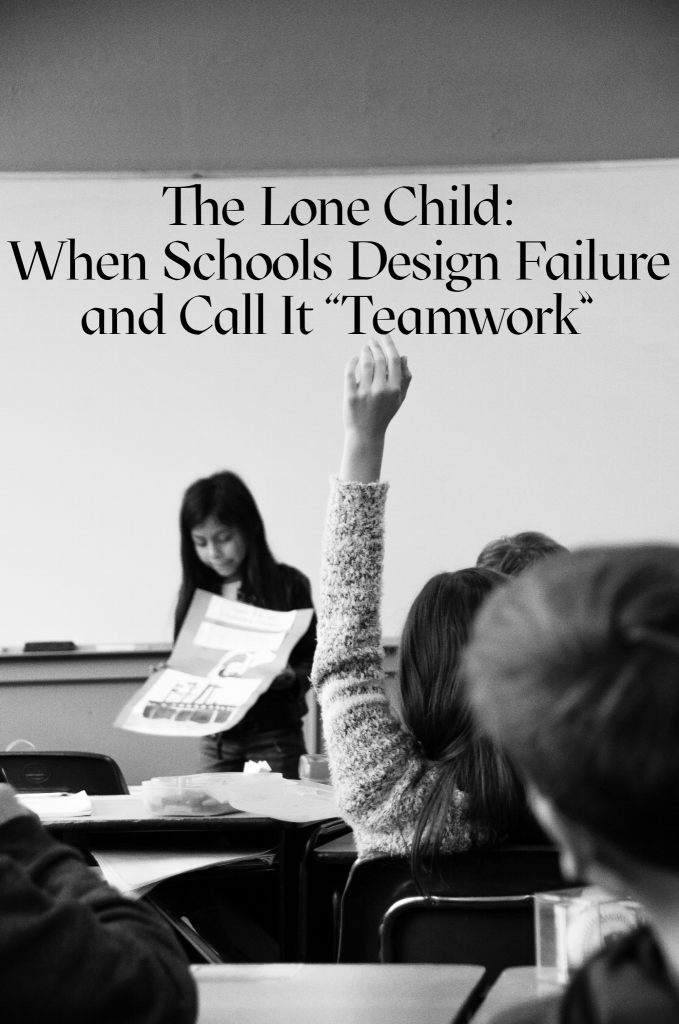
The Lone Child: When Schools Design Failure and Call It “Teamwork”

How do you teach your child to rise — when every system is rigged to keep them on their knees?

Sending Your Child to School in a War Zone (Without Armor)

It takes a certain kind of courage to send your child into a building every day where they are hated. Not disliked. Not unpopular. Hated. Viciously, irrationally, religiously — as if hating your child is a moral obligation for the rest of the student body.

Because if someone dares to be kind? If someone dares to not mock, exclude, or dehumanise your child — then they’ll become the next target. Welcome to the psychology of mob mentality. Welcome to the cowardice of adolescence. Welcome to the failure of a school’s moral backbone.

And still, we send them.

We wipe their tears. Pack their lunches. Zip up their bags and pray. Every morning is an act of faith. Every afternoon, a sigh of relief that they made it home again. Intact.

But resilience? Resilience is not built in peace. It is forged in fire. And my child — my beautiful, brilliant child — is nothing short of flameproof.

But Then the System Gets Involved — and It Gets Worse

You would think the bullying would be the worst of it. The dirty looks. The whispers. The games of “you can’t sit here.” The celebrations when she’s absent. The fake smiles from teachers who know damn well what’s going on.

But no. It’s the curriculum that breaks you.

Group work.

Every. Single. Class.

Even in maths. Even in science. Even in things that should be about logic, about thinking, about independence — schools have swallowed the lie that “collaboration” is the holy grail of learning. So now, your grades don’t just depend on your mind. They depend on whether your tormentors are willing to let you participate.

Spoiler: they’re not.

Your child becomes the child no one wants in their group. Not because she can’t contribute — she can. She’s brilliant. But because associating with her is social suicide. Because exclusion is currency, and everyone is desperate to buy safety.

And worse? These group assignments aren’t optional. They’re worth 50% of the grade in most subjects.

The school doesn’t care. The teachers shrug. “It’s how the world works,” they say. No, it’s not. In the real world, if someone harasses you at work, you can report them. In the real world, you don’t get forced to co-sign your future with someone who hates your guts. In the real world, abusers don’t get to tank your success because they’re too immature to behave like human beings.

But in school? They do.

Resilience Is Not Enough When the System Is Rotten

I’ve raised my child to be resilient. I’ve taught her not to crumble when people throw stones. She’s learned to sit alone at lunch. To read when no one wants to talk. To be strong when the world is cruel.

But how do you teach a child to survive a system that is designed to fail them?

When group tasks are mandatory. When friendships are weaponised. When teachers blame the victim because it’s easier than challenging the mob. When being intelligent, kind, or simply different makes you a target.

What then?

What I’ve Learned: You Can’t Outsmart a Rigged Game, But You Can Call It What It Is

I used to think that if I just taught my child to be stronger, kinder, smarter — we could beat the system. We could outlast the hate. We could rise above it.

But the truth is darker than that.

Because some systems aren’t broken — they’re functioning exactly as designed.

A system that protects bullies and punishes outcasts. A system that rewards silence and punishes advocacy. A system that enforces group tasks and calls it “collaborative learning” — knowing full well that the kids forced into groups are the same kids who get tormented by those groups.

We need to stop pretending this is education. This is sanctioned cruelty with a rubric attached.

Let This Be Your Reminder: Your Child Deserves Better

If your child is going through this, I see you. I see them.

I know what it’s like to help with an assignment your child will never get credit for because her group shut her out. I know what it’s like to have to write emails you know will be ignored. I know what it’s like to watch your child become a shell of who they once were — not because they’re broken, but because they’re being buried alive under the weight of a cruel, cowardly system.

But this isn’t the end.

Keep advocating. Keep pushing. Keep writing. Keep building your child’s strength. Remind them that being excluded by the heartless doesn’t mean they’re unworthy — it means they’re different. And difference is power.

Because if they can survive this, they can survive anything. But let’s make damn sure they don’t have to.

The Birthday Call That Broke Something In Me

When you give your children a choice, and they choose kindness – only to have cruelty meet them at the door.

This morning, I stood at a painful crossroads. It was my mother’s birthday—a woman who has caused me years of pain, manipulation, and deep emotional wounds. A woman who has, despite everything, managed to live on with strength seemingly drawn not from grace or goodness, but from control and narcissism.

And today, I gave my children a choice. I sat with them and explained the truth: that they were not required to wish her a happy birthday, that they were free to do whatever they felt in their hearts.

Some of them chose to call her—soft-hearted, young, and innocent—“just in case it’s her last birthday,” they said.

They were being bigger than the pain. They were doing what they thought was kind.

And so we called.

And called.

And called again.

Only to discover the truth: my mother has blocked me. Her phone wouldn’t ring. Her number refused our calls. The hopeful little faces beside me slowly turned to confusion, then sadness.

She blocked me—and by doing so, she blocked her own grandchildren too.

Not even for her birthday would she allow us the dignity of reaching out. Not even for the sake of the children.

And I realised, in that moment, how deep her cruelty runs.

This wasn’t just rejection—it was deliberate. Strategic. Her own warped version of punishment. A final insult wrapped up in silence.

I watched my children try to make sense of it. I watched them hurt, quietly. And I ached, not just for them, but for the part of me that still, after everything, hoped for decency. Hoped for something better.

But this is the lesson.

This is the truth.

You cannot force love where love has never lived.

And no matter how good you are, how pure your heart, how brave your children…

You cannot squeeze water from a stone.

And you cannot heal through hope alone.

Today, my children saw what I’ve spent a lifetime surviving.

Today, I stop feeling guilty for the boundaries I set.

And today, I hold my head high, knowing that even if the door was slammed in our faces, we tried. We tried with grace.

We tried with love.

And she chose silence.

That’s not our failure.

That’s her legacy.

No Flowers at the Gate: What Silence Says When a Child Is Gone

When a School Forgets, the Pain Echoes Louder

There were no flowers tied to the school gates.

No ribbons.

No teddy bears.

No candles.

No cards.

No signs of heartbreak.

No signs that a child—one of their own—had just disappeared forever.

If this was truly unexpected… where is the shock?

If this was truly an accident… where is the devastation?

What we see instead is silence. An eerie, telling silence that speaks volumes about what this community really feels—and what it doesn’t.

The Hidden Cost of Protecting Bullies

This student—bright, fragile, kind—was hidden away from regular classes “for her own protection.” Her attendance faded. Her light dimmed. She was removed from classrooms rather than removing the ones tormenting her. She was made invisible, as though her pain was inconvenient.

The bullies? They stayed. They were allowed to learn, laugh, exist—untouched.

The school didn’t teach accountability. It taught cruelty a safe place to thrive. It showed the entire student body that if you push hard enough, we won’t protect the victim—we’ll erase them. Quietly. Without fuss. Without justice.

And now they’ve erased her completely.

No Signs of Grief, No Symbols of Shock

In the wake of any true tragedy—especially the sudden, accidental death of a child—you expect to see a community shaken to its core. You expect flowers. Cards. Mourning students clustered at the gates. A ripple of grief that cannot be contained.

But here? There’s nothing.

Not a single child has tied a ribbon.

Not a single tribute stands at the place where she once walked.

This isn’t just silence. It’s willful erasure. It’s guilt. It’s complicity.

Because deep down, they all know.

They know what she endured.

They know how many years she was targeted, pushed, alienated.

They know what they said to her—and what they didn’t say when it mattered.

They know what kind of school culture allowed this to happen.

So there are no flowers. Because that would mean facing it.

And facing it would mean admitting they were part of it.

What Are We Really Teaching Our Children?

The message is loud and clear:

If you are cruel enough, the school will protect you.

If you are suffering, we will hide you—then forget you.

This is not just a tragedy. It is a teaching moment lost. A warning silenced. A life erased without consequence.

What the school is doing now—brushing it under the rug, refusing to speak her name, pretending nothing happened—is the same thing they did when she was alive. Deny. Minimize. Move on.

But the pain lingers. The questions remain. The truth doesn’t go away.

Silence Isn’t Respect—It’s Evasion

Some say we should respect her memory by not asking questions.

But how can you respect someone’s memory if you won’t even acknowledge their pain?

How do you honor a life while pretending the cruelty that shadowed it never happened?

This isn’t respect. It’s fear.

It’s fear of accountability.

It’s fear of confronting the toxic culture that was allowed to flourish under their watch.

And that fear has cost a life.

Let this not be another forgotten name.

Let this silence not be the final word.